
Completed examples
From approved notes to a finished resource.
You have downloaded a workbook before and watched it sit unused in a folder. The step that decides whether a resource gets used comes before the design: the brief. Below, two approved source notes become a completed brief, and that brief becomes a checklist a reader can finish in one sitting.
All examples are illustrative. The source notes were written for the workbook; no client or result is real.
Example of a completed planning brief
Agency client-kickoff checklist
One of the three worked examples in the free Brief Builder.
Illustrative scenario written for the workbook. No client result is claimed.
One demonstration. Three stages.
Follow one idea the whole way: a note you already own, the decision it forces, and the checklist a reader ends up holding in a client meeting. The same scenario is one of the worked examples in the workbook.
Two approved source notes
| S1 · Kickoff process note | Before kickoff, collect the project objective, approval owner, required assets, timing constraints and unresolved questions. |
|---|---|
| S2 · Service scope note | The agency offers an onboarding-process review. It examines the intake workflow and recommends scoped changes; it does not guarantee revenue results. |
The one-page brief
| Audience | Owner of a small marketing agency preparing a new client kickoff. |
|---|---|
| Problem | Project inputs and approval responsibilities are scattered across messages. |
| Useful outcome | Complete one intake brief identifying required inputs and remaining gaps. |
| Related offer | An onboarding-process review of the agency's intake workflow. |
| Format and core | Checklist: objective, approval owner, assets, timing, open questions. Based on S1. |
| Sources | S1 supports the steps; S2 supports the offer and its limits. |
| Next action | Request a review through the agency's verified enquiry page. |
| Limits | No client names, invented results or guarantees. |
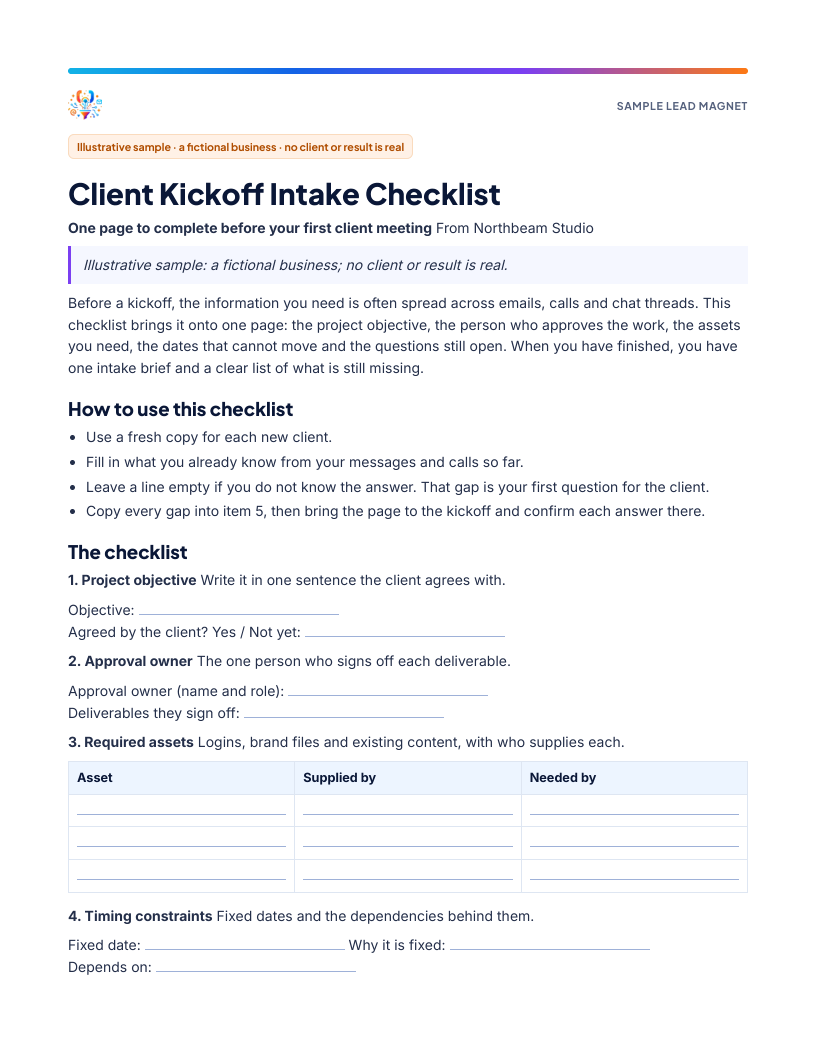
Client Kickoff Intake Checklist
Complete this before your first client meeting. Leave a box empty if the answer is unknown; that gap is your first question.
- Project objective, written in one sentence the client agrees with.
- Approval owner: the one person who signs off each deliverable.
- Required assets: logins, brand files and existing content, with who supplies each.
- Timing constraints: fixed dates and dependencies.
- Open questions, each with an owner and a date.
Notice what the brief did: every checklist line traces to S1, the offer wording stays inside S2, and nothing claims a client result. That is the job of the planning stage.
Copy the shape, not the wording. One approved note behind each checklist step, one offer sentence that states its own limits, and one next action that points to a real enquiry route. Do that and the resource reads like your practice rather than a template with your logo on it.
Download three complete sample bundles.
Each bundle is a whole campaign for a fictional business: the brief, the finished resource, the landing-page copy, five email drafts and a source report. Every file is labelled illustrative, and the businesses and people are invented.
Client Kickoff Intake Checklist
Northbeam Studio, a fictional small agency. One brief, the lead magnet, landing-page copy, five emails and a source report.
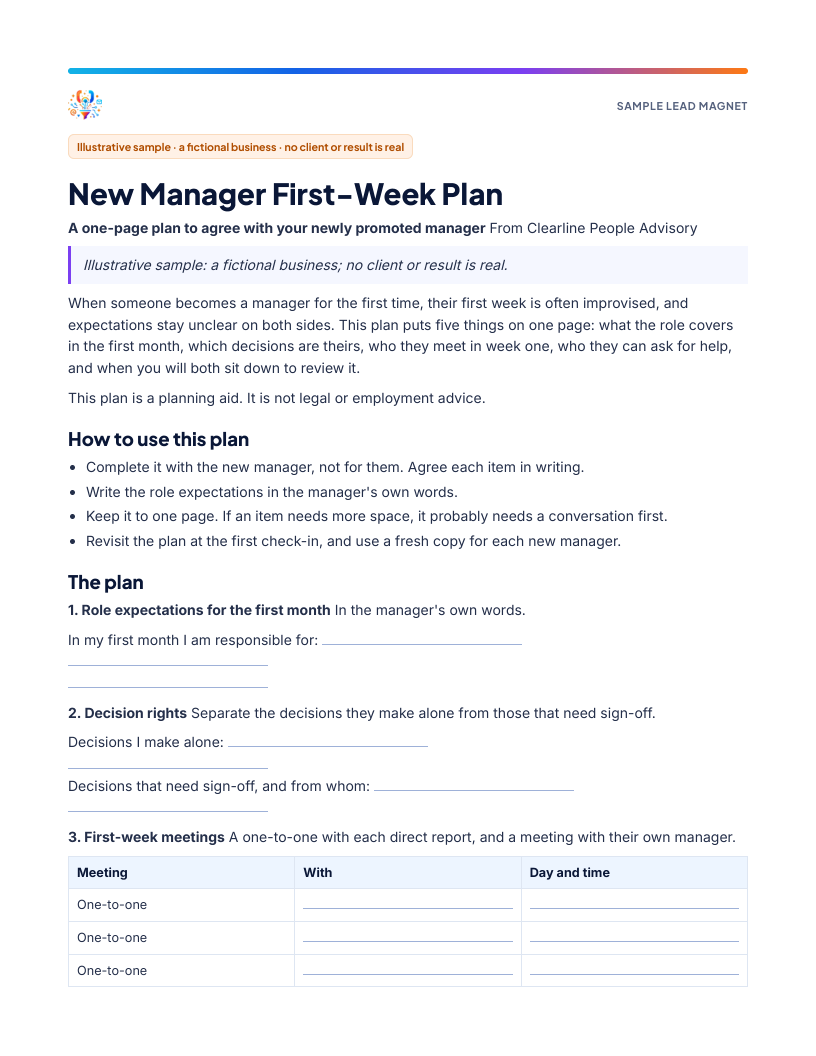
New Manager First-Week Plan
Clearline People Advisory, a fictional HR consultant. One brief, the lead magnet, landing-page copy, five emails and a source report.
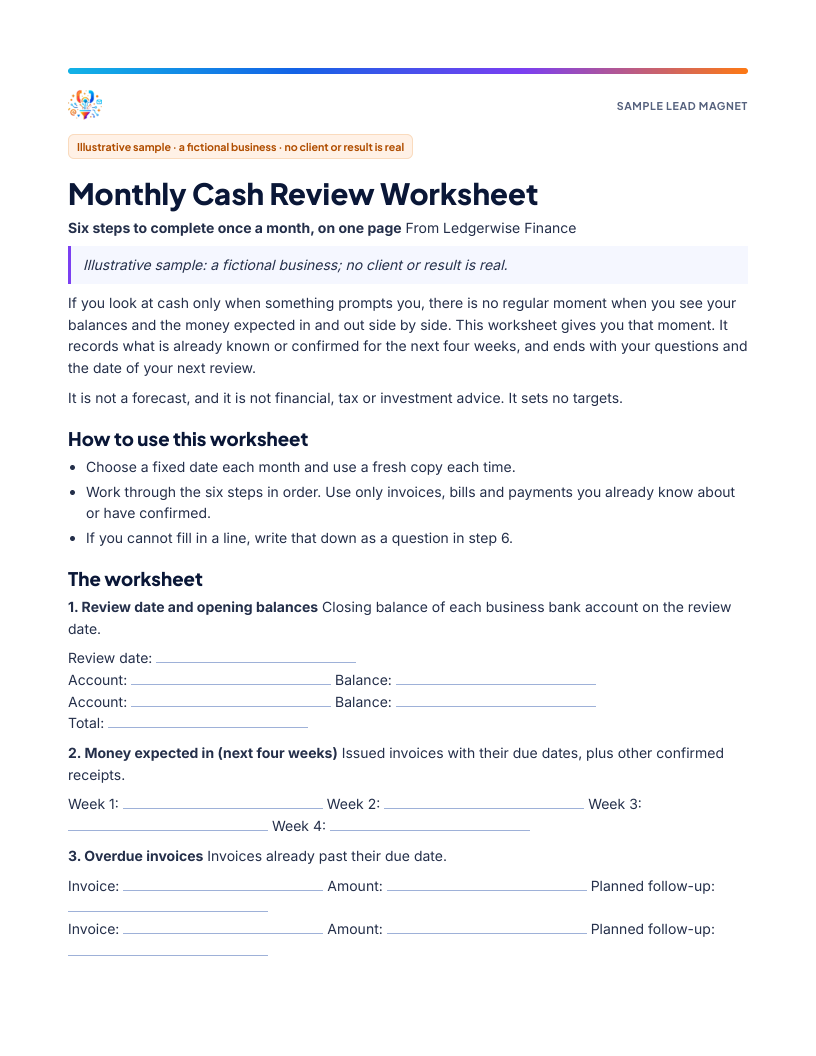
Monthly Cash Review Worksheet
Ledgerwise Finance, a fictional fractional CFO. One brief, the lead magnet, landing-page copy, five emails and a source report.
How to use a bundle in three steps. 1) Put your own brief beside 01-brief and check each of the eight fields is as specific. 2) Compare your source notes with 05-source-report: every claim you plan to make should trace to a note in the same way. 3) Copy the structure of 04-emails (not the wording) into your own email tool, then write your own messages from your brief.
| In each bundle | What it is for |
|---|---|
| The one-page brief | The eight decisions behind the resource, with the approved source notes. |
| The lead magnet (branded PDF) | The finished checklist or worksheet a reader downloads. |
| Landing-page copy | Headline, what you get, who it is for, form and consent wording, FAQ. |
| Five email drafts | Delivery, a quick win, teaching, a worked example and a no-pressure offer, ready to rewrite in your own voice. |
| Source report | Every claim traced to a source note, plus what was removed as unsupported. |
| Editable text | Markdown and plain-text copies of everything, ready to paste into your own tools. |
Sample bundles drafted with AI assistance, then edited and checked by our editorial team. The businesses, people and figures are fictional; no client or result is real.
A second example: an independent consultant.
The same eight fields for a solo expert. Illustrative and fictional; adapt the wording to your own offer and sources.
This is the version to copy if you sell your own time. Start with the audience row: it names a company size and a situation, not an industry. That single choice is what keeps a checklist short enough to finish and specific enough to be worth finishing.
| Audience | Owners of 10–30 person companies promoting their first team manager. |
|---|---|
| Problem | The new manager's first week is improvised, so expectations stay unclear. |
| Useful outcome | Complete a one-page first-week plan for the new manager. |
| Related offer | A scoped manager-onboarding review by the consultant. |
| Format and core | Checklist: role expectations, decision rights, first-week meetings, support contacts, first check-in date. Based on C1. |
| Approved sources | C1: the consultant's own onboarding process notes. C2: the service scope note. |
| Next action | Book a scoping call through the consultant's verified enquiry page. |
| Limits and reuse | No legal or employment advice, client names or outcome claims. Reuse for each new manager. |
Why this brief works
- One reader with one situation, not "all business owners".
- An outcome the reader can finish in one sitting.
- An offer that extends the same problem, so the next step feels natural.
- Every checklist line comes from notes the consultant already owns.
Your own material is what stops a resource sounding like every other download in the folder. If your notes are about restructuring conversations, pricing decisions or board reporting, use those. The lines should read like your process, because that is what a reader recognises as yours.
The free Brief Builder includes the blank one-page brief and the agency example.
Finished a brief? Here is what comes next.
Every next step below is free. One card names our own paid product, for readers who want it.
Draft, check and promote it yourself
- Draft from the brief in your own editor.
- Review every claim with the Source & Claim Review Checklist.
- Write the page, post and delivery email with the Promotion Copy Template.
Lead Magnet Workflow Pack ($79)
Templates and checklists for the steps after your brief: brief templates, a format decision tree, a vendor scorecard, copy blocks and a launch checklist. One-time purchase. You do not need it to use anything on this page.
If you take one thing from these examples, take the order of work. Open the notes for a service you already deliver, choose the relevant decisions, and write them as checklist lines. Then name the service that follows from the gaps the checklist exposes. That is a brief, and it is the part worth getting right before any other choice.
Write your own brief next.
Start on Worksheet H of the free Brief Builder and use these examples beside it.
Free: we send you a short email first. Reply VERIFY to it and we email you the workbook, then four short follow-up emails over two weeks (the last one names our own $79 Workflow Pack). Every email has an unsubscribe link.